Foreigners can buy a villa in any Turkish province outside military zones, and no residence permit is needed first. The real decision sits on the title deed more than on the map: of two villas that look the same, one may meet the residence and citizenship rules while the other does not.
Most buyers start with the sea view. The photo looks good, the price seems fair in dollars, and the seller says "the title deed is ready". But a villa is a different asset from an apartment: the classification of the land under it, whether the pool is on the permit and the type of title record all shape your rights directly. So let's take the region first, then the budget, and the paperwork last.
Which villas can a foreigner not buy?
Article 35 of the Land Registry Law and the Investment Office guide draw the limits clearly:
- Military zones: Foreigners cannot acquire property in military prohibited zones or military security zones. Special security zones require the governor's permission.
- Per-person limit: One foreigner can hold up to 30 hectares nationwide.
- District limit: The foreign total cannot exceed 10 percent of a district's private land. If the limit is full, the application is refused.
- Nationality: The President can impose restrictions by country, region and property type, so ask specifically about your own nationality.
In practice a buyer cannot check this list alone. The land registry office reviews the parcel when the application is made, which is why the parcel should be cleared before any deposit is paid.
Where are foreigners buying? What the official data says
In the first nine months of 2026, 15,308 homes were sold to foreigners. Eighty percent of them were in three provinces: Istanbul, Antalya and Mersin.
| Province | Sales | Share of total |
|---|---|---|
| Istanbul | 6,533 | 42.7% |
| Antalya | 4,693 | 30.7% |
| Mersin | 1,031 | 6.7% |
| Ankara | 638 | 4.2% |
| Yalova | 282 | 1.8% |
| Muğla | 248 | 1.6% |
| Izmir | 231 | 1.5% |
| Bursa | 224 | 1.5% |
| Aydın | 145 | 0.9% |
One caution when reading this table: TurkStat does not count villas separately, every home is in these figures. Istanbul's high number may largely come from apartment sales. Muğla, home to Bodrum and Fethiye, recorded only 248 sales in nine months. That does not make it unimportant for villas, it shows that foreign purchases there are few in number. With few transactions, price comparables are harder to find too.
Which region for which purpose?
The right province depends on why you are buying. The table below is a general framework, and there are big differences inside every district.
| Region | Who it suits | Watch out for |
|---|---|---|
| Antalya (Alanya, Kaş, Kalkan, Kemer) | Those wanting foreign neighbours, ready services, year-round living | Residence limits in neighbourhoods with many foreign residents |
| Muğla (Bodrum, Fethiye, Marmaris) | Holiday homes and higher budgets | Zoning on slope and coastal plots, seasonal life |
| Aydın and the Izmir coast (Kuşadası, Çeşme, Urla) | Coast close to a city and an airport | Plots classified as field or vineyard |
| Mersin | Coast on a lower budget | Villa supply may be limited compared with apartments |
| Yalova, Bursa, the Sapanca area | Green, cooler climate, close to Istanbul | Earthquake risk and building documents |
The province you are looking at may not be in this table. Through the network of licensed agents I work with across Turkey, I can arrange an on-site meeting and checks in the region you are considering. If you are interested somewhere not listed, just ask.
The budget reality: how wide do prices go?
There is no reliable nationwide transaction data for villa prices. What we have is mostly asking prices, and those are not sale prices. To see the gap anyway, I looked at sample listings on a portal aimed at foreign buyers in November 2026:
| Region | Asking price | Price per m² |
|---|---|---|
| Alanya | From €450,000 | About €1,500 |
| Antalya | €1,260,000 | €3,818 |
| Bodrum | From €1,950,000 | €8,228 |
The only conclusion to draw from these examples is this: the same phrase, "sea view villa", can hide a gap of more than five times per square metre depending on the region. Before deciding, you need a valuation that asks about real sales on that street. A valuation report is already part of a sale to a foreigner, and it is also useful for seeing whether the price is realistic.
Purchase costs come on top of the price. Title deed fee is 4 percent of the sale price, by law half for the buyer and half for the seller; the revolving fund fee, valuation, interpreter and compulsory earthquake insurance are added. The items are listed one by one in the title deed transfer cost article.
The real villa traps are on the title deed
1. What does the deed say: plot, field, floor easement?
Look at the "nature of property" section. A detached villa may be recorded as a house on a building plot (arsa), while a villa complex usually shows condominium ownership (kat mülkiyeti) or floor easement (kat irtifakı). If the record only says "field" (tarla) or "vineyard" (bağ) and a villa stands on it, ask separately for the building's documents. An unlicensed structure can face demolition and fines.
2. Floor easement and condominium ownership are not the same
Floor easement is the stage before construction is complete or before the occupancy permit (iskan) is issued. On a villa that has not moved to condominium ownership, always ask about the occupancy permit. More detail is in the occupancy permit article.
3. Pools, annexes, extra floors
The deed may be clean and the building may still not match its permit. A pool added later, an enclosed terrace or a garden house does not appear on the deed. Ask the municipality for the building permit and approved project, and compare them with what is actually there.
4. Coast, forest, olive groves
Some plots with views sit near the coastal edge line, a forest boundary or an olive grove area. These can restrict use and building rights. Getting the zoning status from the municipality in writing is the shortest way to see this risk.
5. The two-year rule on empty plots
If you are thinking of an empty plot to build your own villa, the law sets a deadline: a foreigner must submit the project for an undeveloped property to the relevant Ministry for approval within two years. The approved project is recorded on the deed and completion on time is monitored.
6. A notary contract does not give ownership
When buying off-plan, a promise-to-sell contract may be signed at a notary. As the Investment Office also points out, this only promises a transfer and does not pass ownership. Ownership arises only with registration at the land registry office. Check the parcel for mortgages and liens before the application as well.
Residence and citizenship: check whether the villa qualifies first
The $200,000 residence route: renting it out causes problems
According to the migration authority's document list, the home's value on the acquisition date must equal at least USD 200,000. The same list requires that the property be a residence, used by the foreigner for that purpose, and not used for rent or similar income. So the plan "I'll rent it out in summer and get my residence permit too" may run into this condition.
In addition, some neighbourhoods with a rising share of foreign residents can be closed to foreign registration. The latest official statement I could find is from 2023, and closure lists change over time. Before buying, ask the Provincial Migration Office about that specific address.
The $400,000 citizenship route: not every villa counts
Under the regulation, the purchase must be at least USD 400,000 or the equivalent in foreign currency, and a three-year no-sale annotation must go on the deed. A 2023 amendment narrowed the scope: it now requires "property with condominium ownership or floor easement, or land classified as building plot with a building on it".
For a villa, this means a house on a parcel recorded as field, vineyard or orchard may not fit this definition even above USD 400,000. Before you pay, ask the land registry office about it for the certificate of eligibility. Remember that the decision rests with the President; the purchase gives a right to apply.
Buying a villa without coming to Turkey: the steps
- Look up the parcel. At parselsorgu.tkgm.gov.tr basic information is available from anywhere in the world using province, district, block and parcel.
- Ask for the documents. Title record, zoning status, building permit, occupancy permit and lien information. Do not rely on the seller's word.
- Get a tax number and bank account. These can also be handled through a representative; confirm with your bank.
- Prepare a power of attorney. It can be issued by a Turkish consulate or a competent authority. Hague Convention countries need an apostille, then a notarised Turkish translation. The authority to purchase must be stated explicitly.
- Valuation and payment. The payment route for foreign buyers and the Foreign Exchange Purchase Certificate are covered in this article. The mandatory start of the Secure Payment System was postponed to 1 December 2026; ask about the current status for your purchase date.
- Land registry appointment. Book at randevu.tkgm.gov.tr or by calling Alo 181. A party who does not speak Turkish needs a sworn interpreter, and buildings need compulsory earthquake insurance.
The process being the same in every province makes things easier, but the parcel check has to be done on site. If you would like to go through a villa's documents together before signing, write to me. If you would like professional guidance, feel free to get in touch.
Frequently asked questions
Can foreigners buy a villa anywhere in Turkey?
Do I need a residence permit to buy a villa in Turkey?
Does buying a villa give me a residence permit?
Can I get Turkish citizenship by buying a villa?
Can I buy an empty plot and build a villa?
Acquisition limits and project duty: Land Registry Law No. 2644, Article 35; Presidency Investment Office, Acquiring Property and Citizenship.
Citizenship rule: Regulation on the Implementation of the Turkish Citizenship Law, Article 20 (as amended by Presidential Decisions 5554 and 7938).
Residence permit: Presidency of Migration Management, short-term residence permit documents; Law No. 6458, Article 31. Neighbourhood closures: Istanbul Provincial Migration Office statement, 18.06.2023.
Sales data: TurkStat, home sales to foreigners by province, January-September 2026 (total 15,308 homes). Price examples: HomesOverseas.ru listings, viewed in November 2026; these are not transaction prices.
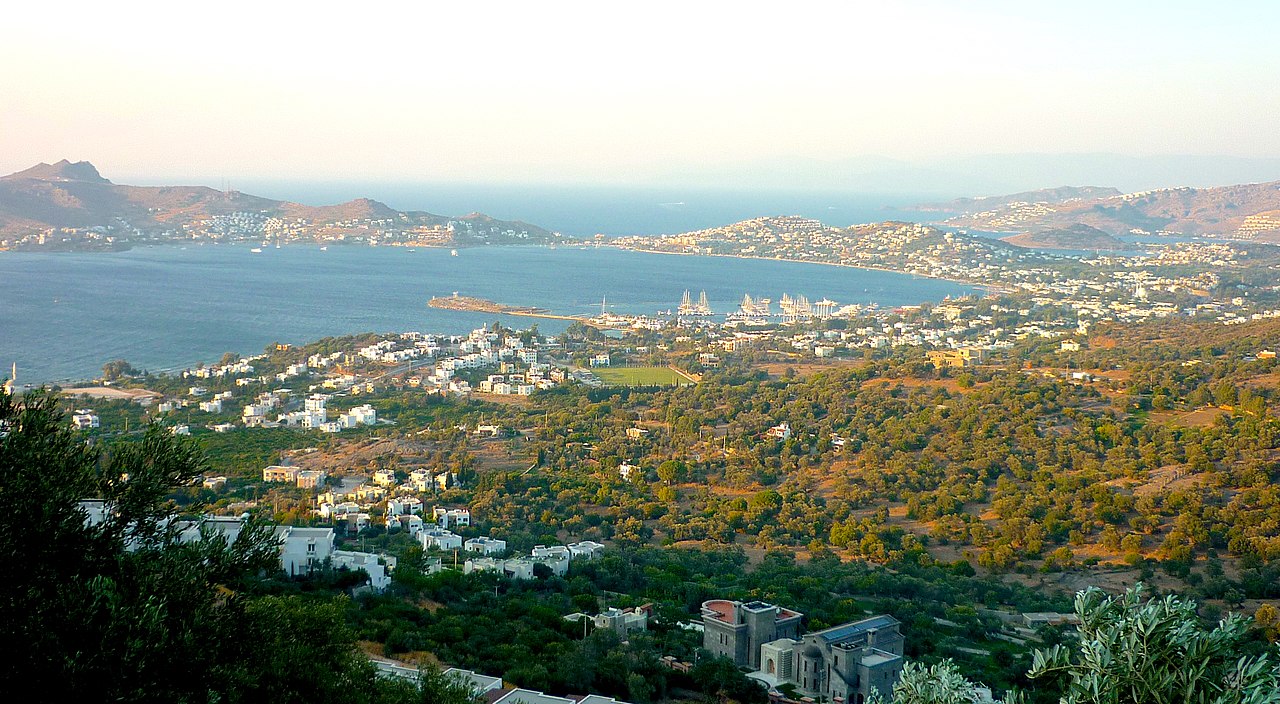
Cover image: DoubleGrazing, Wikimedia Commons, CC BY-SA 4.0.
This article is general information, not legal advice. Rules can change. Have the parcel and your own nationality's status confirmed before you buy.